Truck loader cranes explained: lifting moment in metre-tonnes, size classes and reach, knuckle-boom vs telescopic, payload loss, inspections and makers.
A loader crane makes the truck independent: scaffolding, pallets, precast elements, containers or machinery can be unloaded on site without a forklift and without a mobile crane. Mounted behind the cab, it folds away for driving and, depending on size, reaches 8 to over 30 m when extended. Which designs and size classes exist, what lifting moment and load capacity mean, how much payload the crane costs, who builds them, and what matters when buying and selling used loader cranes.
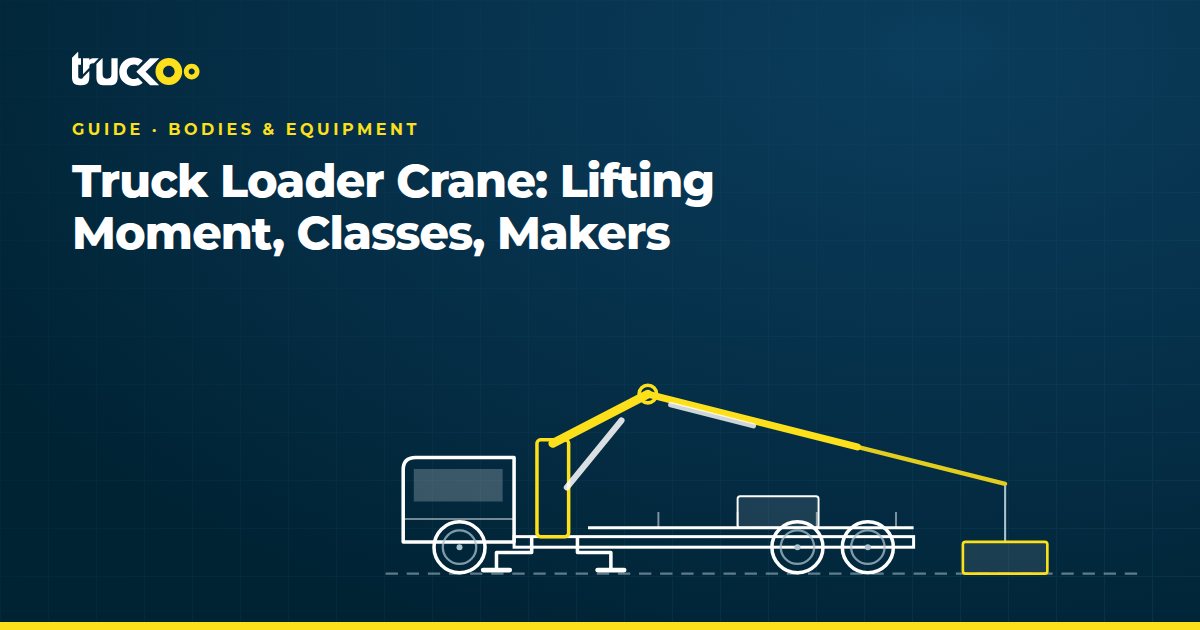
A loader crane (truck-mounted crane, an alternative to an on-board forklift, called a loader crane or knuckle boom crane in English) is a hydraulic knuckle-boom crane on a truck chassis used to load and unload the vehicle itself. It consists of a column, main boom, knuckle boom and telescoping extensions, stands on extendable outriggers and is supplied with hydraulic pressure via a power take-off on the gearbox. It is operated using cross-levers on the vehicle or – now standard – by radio remote control, which lets the driver keep an eye on the load.
What sets it apart from a mobile crane is its purpose: a mobile crane is a working machine whose sole purpose is lifting. A loader crane is an attachment on a transport vehicle – it complements the load bed instead of replacing it. Typical carriers are flatbed trucks, building-materials trucks, tippers and skip loaders.
The size of a loader crane is not stated in tonnes but in metre-tonnes (mt) of lifting moment – the product of load and outreach. A crane rated at 15 mt can theoretically lift 15 t at 1 m, 5 t at 3 m or 1.5 t at 10 m; in practice the figures are lower because of the extensions' own weight. The binding figures are given in the manufacturer's load chart, which must be fitted to the crane.
The common design: main boom and knuckle boom fold together behind the cab, giving low height in driving position and good reach upward and to the rear.
A straight, multi-stage telescoping boom without a knuckle joint – simpler, more robust and cheaper, but less maneuverable. Common on recovery vehicles and in steel trading.
Mounted at the rear of the vehicle instead of behind the cab. Advantage: a clear load bed and better visibility when loading; disadvantage: the crane loads the rear axle and rules out a tail lift.
Grabs for timber, scrap and bulk material, brick and pallet forks, winch, work platform (only with a crane approved for it and personnel-carrying certification), vacuum lifters for glass and panels, concrete skips. Every attachment changes the dead weight and the load chart.
Four- or six-point support, extended hydraulically or manually. The outrigger spread determines how much can be lifted to the side – modern cranes monitor outrigger position electronically and limit the load accordingly.
A loader crane weighs 1.5 to 5 t depending on class, more for heavy-duty cranes – and this weight comes entirely off the payload. A 26-tonner with a 20-mt crane thus loads only around 11 to 13 t instead of 15 to 16 t. Then there is axle-load distribution: a crane behind the cab mainly loads the front axle, a rear-mounted crane the rear axle. Both must suit the chassis and are calculated during installation. If unladen weight or dimensions change, a modification inspection with entry in the Zulassungsbescheinigung (vehicle registration certificate) is required.
Palfinger (Austria) leads the world market, followed by Hiab (Finland, with the Hiab and Loglift/Jonsered forestry brands), Fassi (Italy), Effer, PM Group, Amco Veba, Cormach, Atlas and HMF (Denmark); in forestry additionally Epsilon (Palfinger), Penz and Kesla. Among used vehicles, Palfinger, Hiab and Fassi are the most common – with the densest service and spare-parts network in Europe and the strongest export demand.
A working, inspected loader crane raises a truck's price considerably – often by more than a comparable vehicle without a crane costs outright, because retrofitting and a modification inspection are expensive and building-materials trading, scaffolding companies and municipalities cannot work without a crane. Conversely, a defective or uninspected crane acts as a deduction: buyers factor in repair, inspection and downtime. Value is driven by the crane's manufacturer, lifting moment, year of manufacture and operating hours, number of extensions, radio remote control, attachments, structural condition and the crane inspection log. In export, Palfinger and Hiab are the most sought-after brands; which age limits apply there is covered in the guide Exporting used trucks. Which documents a sale needs – including the crane inspection log – is covered in the guide important documents for selling a truck. A specific figure for your vehicle is provided by the free valuation based on real sales; verified dealers from 35+ countries then bid with binding offers – sell a truck with loader crane with truckoo.
The metre-tonne (mt) is the lifting moment of load times outreach. A 15-mt crane can theoretically lift 15 t at 1 m or 1.5 t at 10 m; the manufacturer's load chart on the crane is always the binding figure.
That depends on lifting moment and outreach. A 20-mt crane on a 26-tonner lifts several tonnes close to the vehicle, and usually still around 1.2 to 1.5 t at 12 m outreach.
Yes, at least once a year by a competent person under the accident-prevention regulations, documented in the crane inspection log; in addition there are recurring expert inspections after a certain number of operating years or load cycles, and an annual inspection of the lifting accessories.
1.5 to 5 t depending on class. A 26-tonner with a 20-mt crane loads only about 11 to 13 t instead of around 15 t.
Yes, provided the frame, axle loads, power take-off and hydraulics are suitable. Since unladen weight and usually the dimensions change, a modification inspection and entry in the Zulassungsbescheinigung (registration certificate) are required.
Palfinger, Hiab and Fassi – because of spare-parts supply, service network and stable export demand; in forestry, Epsilon and Loglift as well.

Gabriel Böhm is Managing Director of truckoo GmbH, the digital platform that is redefining commercial vehicle trade in Europe. With a passion for innovation and efficiency, he shapes the strategic direction and drives operational excellence to connect sellers and buyers smarter, faster and more transparently.
More practical knowledge about selling, valuation and documents.
The registration certificate, mileage and photos are all you need. Verified dealers bid bindingly and you decide – free of charge and with truckoo as your contractual partner.

.svg)