Dump truck types explained: rear, two-way and three-way tippers, sizes from 3.5 t to semi-trailer dump trucks, payload, steel or aluminium body, makers.
Dump trucks are the workhorses of the construction industry: raise the bed, the bulk material slides out, and it's on to the next site. The range spans from the 3.5 t van-based tipper through the three-way dump truck to the 8x4 four-axle rigid and the semi-trailer dump truck with 27 t payload. This guide sorts the types by tipping direction, vehicle class and body, states payloads, manufacturers and inspection duties – and shows what matters when buying and selling used dump trucks.
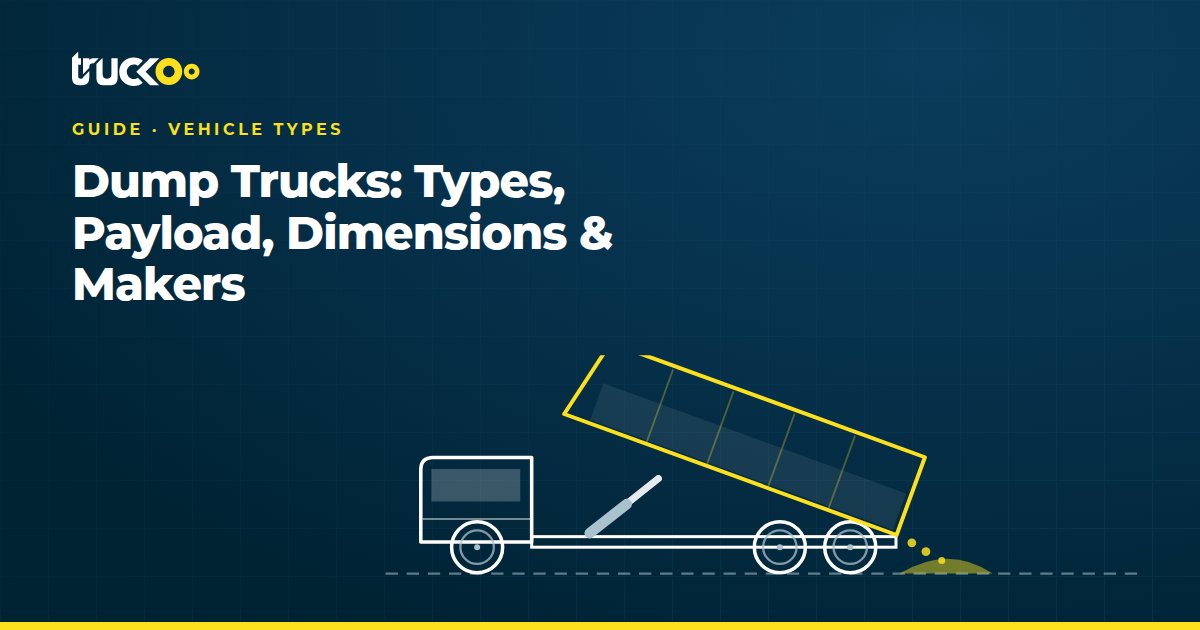
A dump truck is a commercial vehicle whose load bed is raised hydraulically so the load slides out under its own weight. This unloads a full load in one to two minutes without an excavator, crane or manual labour – which is why sand, gravel, excavated soil, construction debris, asphalt, grain, wood chips and scrap metal are hauled almost exclusively in dump trucks. The body is correspondingly rugged: a reinforced subframe, thick side walls, a flat steel or aluminium floor, and at the rear a pendulum tailgate that swings open automatically when tipping.
Tipping is done via a telescopic cylinder. On a front-tipper it sits at the front bulkhead and pushes the body backward; on an underfloor tipper it sits beneath the load bed and lifts it from the centre – a prerequisite for three-way tipping. The hydraulics are driven by a power take-off on the gearbox.
Tips only to the rear, against the direction of travel. The simplest, cheapest and most stable design, with the highest tipping angle and the greatest payload – standard on heavy construction trucks, semi-trailer dump trucks and anything hauling excavated soil and construction debris.
Tips to the right and left, not to the rear. Rare as a truck body, more common on agricultural and municipal trailers when unloading sideways into a windrow or silo.
Tips to the rear, right and left; all three side panels can be unhinged individually. The most flexible design and therefore the standard in trades, landscaping and garden construction, municipalities and the building-materials trade – wherever material is unloaded beside a site without room to manoeuvre. The trade-off: somewhat less payload and a more complex tipping frame.
The term "Muldenkipper" covers two different things in German. On public roads it means the truck with a tipping body. In open-pit mining and on large construction sites it refers to articulated dumpers and rigid heavy-duty haul trucks from Caterpillar, Komatsu, Liebherr, Volvo CE, Bell and Hitachi with 25 to over 400 t payload – off-road plant with no road-registration, transported on a low-loader. Anyone searching for a road-going "dump truck" of this kind usually means the rear tipper.
On a classic dump truck the body is permanently fixed to the vehicle. On hooklift/skip systems it is not: the roll-off tipper pulls standardised containers of 10 to 40 m³ lengthwise onto the frame via a hook and can also tip them; the skip loader lifts smaller skips of 3 to 10 m³ over the rear with two telescopic arms. Rule of thumb: haul the same material every time and you want the fixed dump truck; leave containers standing at the customer's site and you want the demountable system.
Among body builders, Meiller leads the European market, alongside Schmitz Cargobull, Kögel, Carnehl, Langendorf, Fliegl, Schwarzmüller, Kässbohrer, Wielton, Menci, Bennes Marrel and Hüffermann; dump bodies for vans and light trucks come from Meiller, Schoon, Palfinger and Dautel. Chassis come from Mercedes-Benz (Arocs, Atego), MAN (TGS, TGM, TGX), DAF (CF, XF, XD), Scania (P, G, XT), Volvo (FMX, FM), Renault (C, K) and Iveco (Trakker, X-Way, Eurocargo). The most sought-after used units are 8x4 and 6x4 rear tippers with a Meiller steel body and semi-trailer dump trucks from Schmitz, Kögel and Carnehl.
Dump trucks hold their value better than long-haul tractor units: demand from construction, municipalities and export markets is steady, the technology is simple, and construction-site vehicles often have low mileage despite hard work. Value is driven by axle configuration and drive (8x4 and 6x4 ahead of 6x2), the body manufacturer and condition, operating hours, frame and spring condition, emissions standard, and HU and SP status. In exports to Eastern Europe, North Africa, West Africa and the Middle East, dump trucks 12 to 18 years old are also in demand – the age limits and emissions standards the target countries require are covered in the guide exporting used trucks. A concrete figure for your vehicle comes from the free valuation based on real sales; verified dealers from 35+ countries then bid on a binding basis – sell your dump truck with truckoo.
By tipping direction: rear tipper (single-way tipper), two-way and three-way tipper; by vehicle class: van-based tippers up to 3.5 t, 7.5- and 12-tonners, 18 t two-axle, 26 t three-axle, 32 t four-axle, semi-trailer dump trucks and tipping trailers.
The rear tipper tips only to the rear, has a higher tipping angle, more payload and a simpler body. The three-way tipper also tips to the right and left, making it more flexible, but heavier and more expensive.
Vans up to 3.5 t roughly 1 t, 7.5-tonners 3 to 4 t, 18 t two-axle 9 to 11 t, 26 t three-axle 14 to 16 t, 32 t four-axle 18 to 20 t, semi-trailer dump trucks in a 40 t combination 24 to 27 t. The binding payload figure is stated in the Zulassungsbescheinigung Teil I (German vehicle registration certificate part I) as the difference between field F.1 and field G.
On public roads, a truck with a fixed tipping body, usually a rear tipper. In open-pit mining and earthmoving, the articulated dumpers and rigid heavy-duty haul trucks from Caterpillar, Komatsu, Liebherr or Volvo CE with 25 to over 400 t payload – off-road plant with no road registration.
Steel for construction debris, scrap and sharp-edged material because it is more wear-resistant; aluminium for gravel, grain and asphalt because it is 800 to 1,500 kg lighter and therefore gives more payload per trip.
Category B up to 3.5 t, C1 up to 7.5 t, C above that, CE with a trailer or as a semi-trailer dump truck. Code 95 (Schlüsselzahl 95) is additionally required for commercial goods transport.

Gabriel Böhm is Managing Director of truckoo GmbH, the digital platform that is redefining commercial vehicle trade in Europe. With a passion for innovation and efficiency, he shapes the strategic direction and drives operational excellence to connect sellers and buyers smarter, faster and more transparently.
More practical knowledge about selling, valuation and documents.
The registration certificate, mileage and photos are all you need. Verified dealers bid bindingly and you decide – free of charge and with truckoo as your contractual partner.

.svg)