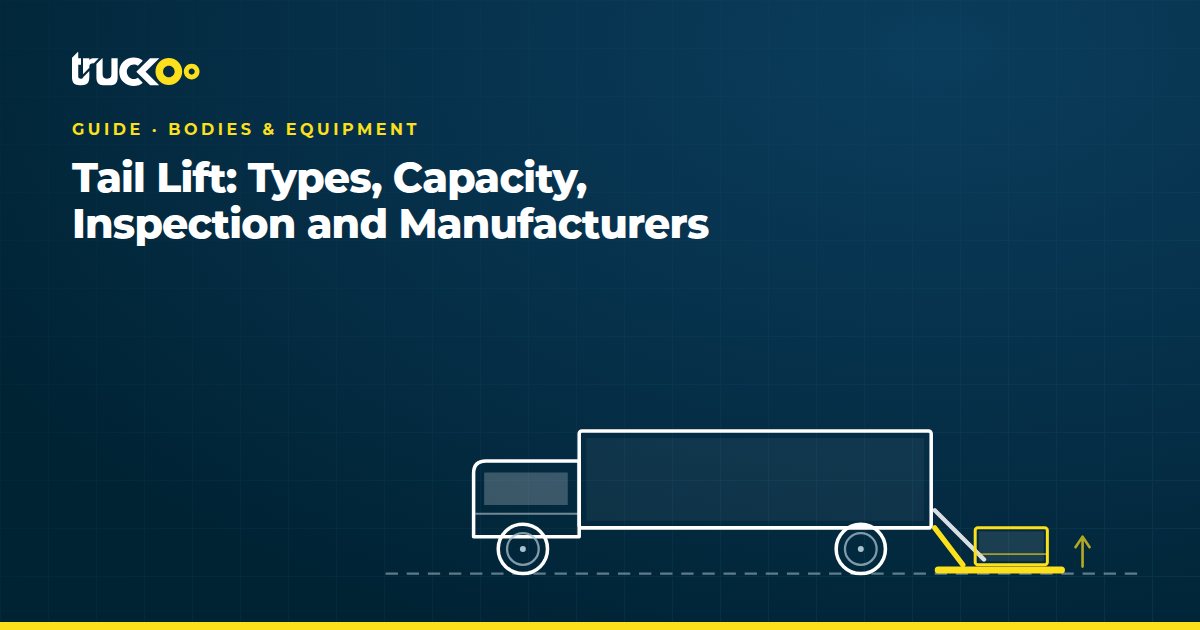
Standard, folding, tuckaway or column lift: types, lifting capacity by vehicle class, weight, annual inspection duty, manufacturers and what to check used.
A tail lift turns any truck into a loading ramp: the hydraulic platform at the rear raises pallets, roll cages and machinery from ground level to load-floor height – no forklift, no dock, just one driver. That is why it is standard in distribution transport, furniture haulage, the beverage trade and parcel delivery. Which types exist, how much they lift, what they cost in payload, which inspection duty applies and what to look for when buying and selling.
A tail lift (in German: Ladebordwand, LBW or Hubladebühne) is a hydraulically operated platform at the rear of the vehicle that travels up and down between the road surface and the load floor. In the travel position it forms the rear closing wall or folds away under the vehicle. It is driven by a hydraulic power pack fed from the vehicle battery (12 or 24 V) and operated via a control box, foot switches on the platform or a radio remote control. On trucks it usually also serves as the rear underrun protection.
In the travel position the platform stands upright as the rear wall. Robust, large platform, high lifting capacity – but the vehicle cannot dock at a loading bay without opening the lift first. Standard on box bodies in distribution transport.
The platform folds up and is stowed under the load floor; the rear stays clear for dock loading and rear doors. The best-selling type on box bodies and semi-trailers that unload both at docks and on the road.
Retracts completely under the vehicle floor and is only pulled out for use. The load floor stays entirely free and docking is possible without any conversion; the trade-off is smaller platforms and lower lifting capacity. Popular in furniture and beverage logistics.
The platform slides horizontally under the vehicle, similar to the tuckaway lift but with a larger platform. For swap bodies and trailers that frequently use loading docks.
Two vertical columns at the rear guide the platform straight up. Large, level platforms with high lifting capacity but no tilt function – the classic choice for furniture boxes and removal vehicles.
Lightweight standard or folding lifts for 3.5-tonne panel vans and flatbeds with a lifting capacity of 500 to 1,000 kg; on panel vans as an internal tail lift behind the doors. How much payload is left on the van afterwards is explained in the guide on flatbed trucks.
The lifting capacity applies at the load centre, usually 600 to 750 mm from the vehicle edge; further out, the permissible load decreases. What matters is what is actually lifted: a 300 kg roll cage does not need a 2-tonne lift, a 1,200 kg pallet of tiles does.
Depending on type and lifting capacity, a tail lift weighs 250 to 800 kg – and that comes straight off the payload. A 3.5-tonne van with a lift is often left with only 700 to 900 kg, a 7.5-tonner with a box body with around 2.5 to 3 t instead of 3 to 3.5 t. Anyone who depends on payload chooses a lightweight aluminium lift or a higher weight class. The binding figures are in the Zulassungsbescheinigung Teil I (registration certificate part I, field F.1 minus field G).
Dhollandia (Belgium, market leader in Europe), Bär Cargolift (Germany), Palfinger Tail Lifts (formerly MBB, Germany), Hiab with Zepro, Del and Waltco, Sörensen, Anteo (Italy) and Dautel. On used vehicles, Dhollandia, Bär and Palfinger/MBB are the most common – with the best parts and service network.
A working, inspected tail lift noticeably raises the price of a box truck or trailer, because distribution, beverage and furniture transport cannot do without it and retrofitting is expensive. A defective or uninspected lift has the opposite effect: buyers factor in repair and inspection, and for export it often counts only as dead weight. Value is determined by manufacturer, lifting capacity, type (folding and tuckaway lifts are more sought-after than standard lifts), working condition and inspection logbook. A concrete figure for your vehicle is provided by the free valuation based on real sales; after that, verified dealers from 35+ countries make binding offers – sell a truck with tail lift with truckoo.
Van lifts 500 to 1,000 kg, lifts for 7.5- to 12-tonners 1,000 to 1,500 kg, heavy trucks and trailers 1,500 to 3,000 kg – in each case at the load centre, usually 600 to 750 mm from the vehicle edge.
Yes. As lifting equipment it is subject to an annual inspection by a qualified person under the accident prevention regulations; the inspection is documented in the inspection logbook and confirmed by a sticker on the lift.
Depending on type and lifting capacity, 250 to 800 kg; the weight comes straight off the payload. Aluminium platforms save around 50 to 100 kg compared with steel.
In the travel position the standard lift stands upright as the rear wall and blocks docking at loading bays; the folding lift folds under the load floor so that rear doors and dock loading remain free.
On almost all vans, trucks and trailers, provided chassis, electrics and battery are suitable. If length or unladen weight changes, a modification inspection with registration entry is required.
Gabriel Böhm is Managing Director of truckoo GmbH, the digital platform that is redefining commercial vehicle trade in Europe. With a passion for innovation and efficiency, he shapes the strategic direction and drives operational excellence to connect sellers and buyers smarter, faster and more transparently.
More practical knowledge about selling, valuation and documents.
The registration certificate, mileage and photos are all you need. Verified dealers bid bindingly and you decide – free of charge and with truckoo as your contractual partner.

.svg)