Skip loader trucks explained: telescopic and articulated arms, DIN 30720 skips, payload by class, hooklift comparison, manufacturers, inspections, used check.
The skip loader truck is the vehicle behind the classic construction-site skip: two telescopic arms lift the container over the rear, set it down, collect it again when full and tip it at the landfill – all from the driver's seat or by remote control. That is why it is the most widely used demountable-body vehicle for short distances among skip hire companies, waste disposal firms, construction companies and municipalities. Here you will find which types exist, which skips fit, how much it carries, how it differs from the hooklift, who builds it and what to look for when buying and selling used skip loader trucks.
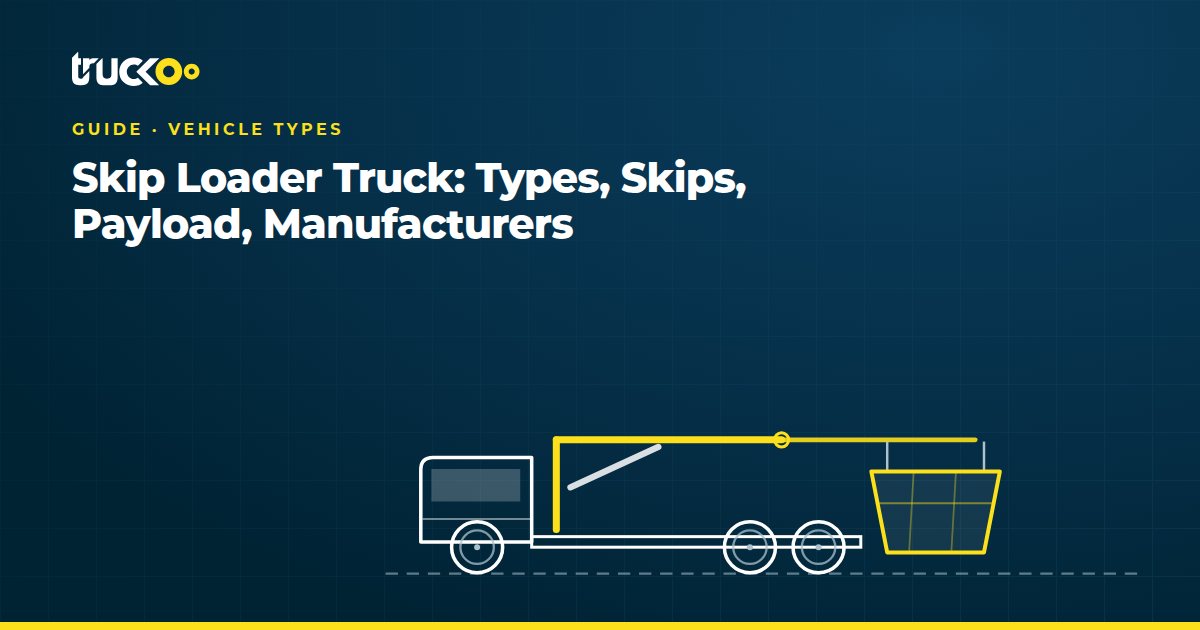
A skip loader truck (skip loader vehicle, skip carrier, German "Absetzkipper") is a truck with two hydraulic telescopic arms behind the cab that engage via chains with the lifting bars of a skip container. The arms swing the skip over the rear onto the road or back onto the frame; for emptying, the skip is locked to the body and tipped backwards. The containers are standardised: skip containers (skips) according to DIN 30720 with volumes of around 3 to 10 m³, open, with lid, with doors or as a swing-flap skip, in versions for construction rubble, excavated soil, bulky waste, commercial waste, green waste and scrap.
The standard design: the arms can be extended, giving greater reach beyond the rear and allowing the skip to be set down behind obstacles or in driveways. Chain length and arm geometry determine which skip sizes and heights can be picked up.
Articulated arms instead of telescopic ones: lower overall height in driving position, important for underground car parks, halls and underpasses. Less reach, but more compact and lighter.
A skip trailer (typically Hüffermann) takes two to four additional skips, which the vehicle itself transfers. This way one truck carries three or four containers on a single trip – standard at larger skip hire companies. Driving licence CE, gross combination weight up to 40 t.
Radio remote control, hydraulic lid opening, quick skip change, stabiliser legs for heavy loads, weighing system, central lubrication, covering system (net or tarpaulin) for load securing of open skips.
The skip loader lifts smaller skips (3 to 10 m³) sideways and over the rear, needs little space behind the vehicle and is ideal for inner-city construction sites, private customers and short distances. The hooklift pulls large containers (10 to 40 m³) lengthwise onto the frame with a hook, carries more, tips heavier loads and tends to run on long routes and for industrial customers. Many waste disposal firms operate both; those with only one vehicle decide based on skip size and operating radius. How tippers differ overall is explained in the guide What is a tipper?.
The skip loader body weighs 1.5 to 2.5 t and is deducted from the payload. The binding values are in the Zulassungsbescheinigung Teil I (registration certificate part I; field F.1 minus field G). Important: a 10 m³ skip with wet excavated soil weighs over 15 t – no 18-tonner can carry that legally. That is why construction rubble and soil go in small skips, bulky waste and green waste in large ones.
Meiller (Germany, market leader with the AK series), Palfinger, Hyva, Gergen, Meier-Ratio, Sträter and Multilift; trailers from Hüffermann. The chassis come from all major truck manufacturers, on the used market most often Mercedes-Benz Atego and Arocs as well as MAN TGM and TGS. For used vehicles, Meiller and Palfinger bodies count the most because of spare parts availability and recognition in export markets.
Skip loader trucks hold their value well: they are constantly sought after by construction companies and waste disposal firms, are robust and in demand in export markets – Eastern Europe, the Balkans, the Middle East, North Africa – even at 12 to 15 years of age, as long as arms, hydraulics and frame are in good order. Value is determined by the manufacturer and lifting capacity of the body, chassis and number of axles, mileage and operating hours, frame condition, emission standard and inspection status; vehicles with radio remote control and trailer coupling achieve more. Which age limits apply in the destination countries is explained in the guide Exporting used trucks. A concrete figure for your vehicle is provided by the free valuation based on real sales; afterwards, verified dealers from 35+ countries submit binding offers – sell your skip loader truck with truckoo.
The skip loader lifts skips of 3 to 10 m³ over the rear with two telescopic arms and chains; the hooklift pulls containers of 10 to 40 m³ lengthwise onto the frame with a hook. Skip loaders are more manoeuvrable and suited to short distances, hooklifts to large volumes and long routes.
2-axle at 18 t around 8 to 10 t, 3-axle at 26 t around 13 to 15 t payload; light skip loaders up to 12 t around 3 to 6 t. The exact value is in the registration certificate.
Skip containers according to DIN 30720 with 3 to 10 m³ – open, with lid, with doors or as a swing-flap skip. Decisive are skip width, lifting bar spacing and the weight of the full skip in relation to the lifting capacity of the arms.
Up to 7.5 t gross vehicle weight class C1, above that class C, with skip trailer CE; in commercial use additionally code Schlüsselzahl 95.
Yes, at least once a year by a qualified person in accordance with the accident prevention regulations, including chains and hooks, documented in the inspection log – in addition to the vehicle's HU and SP.

Gabriel Böhm is Managing Director of truckoo GmbH, the digital platform that is redefining commercial vehicle trade in Europe. With a passion for innovation and efficiency, he shapes the strategic direction and drives operational excellence to connect sellers and buyers smarter, faster and more transparently.
More practical knowledge about selling, valuation and documents.
The registration certificate, mileage and photos are all you need. Verified dealers bid bindingly and you decide – free of charge and with truckoo as your contractual partner.

.svg)