Hooklift explained: hooklift vs. skip loader, vehicle classes, payload, DIN 30722 containers, manufacturers, inspection duties and what to check on used units.
A hooklift truck is the all-purpose truck of the waste and construction industries: instead of a fixed body it carries a hook loader that picks up, sets down and tips standardised roll-off containers in a matter of minutes. One vehicle, any number of containers – which is why hooklift trucks are standard equipment for waste disposal firms, container services, municipalities, construction companies and recyclers. Which systems exist, how much they can carry, how they differ from skip loaders, who builds them and what to look out for when buying and selling used hooklift trucks.
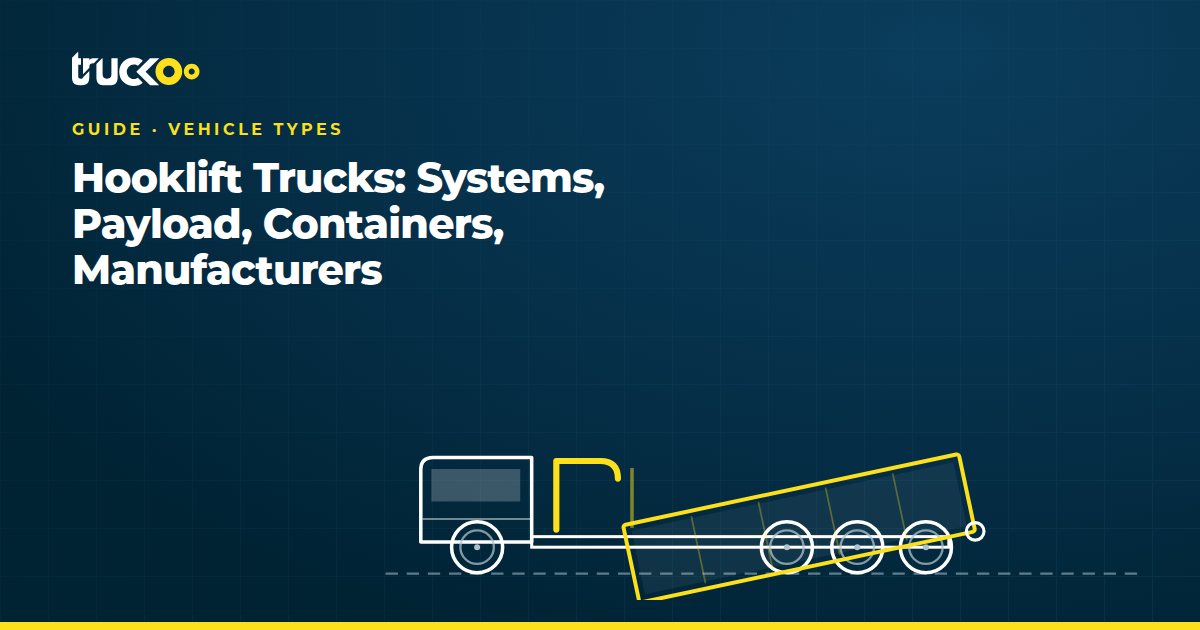
A hooklift truck (hook loader, roll-off truck, German Abrollkipper) is a truck with a hydraulic hook loader mounted on the chassis. The hook engages the bar on the front end of a roll-off container, pulls it over rollers onto the vehicle frame and locks it in place. Unloading works in reverse: the container rolls over the rear rollers onto the ground. The unit can also tip – the container is raised at the rear like a tipper body and emptied. The driver controls everything from the cab or by radio remote control, without ever setting foot on the container.
The containers are standardised: roll-off containers to DIN 30722 with a uniform hook height of 1,570 mm (1,320 or 1,200 mm on lighter vehicles), lengths of 4.5 to 7 m and volumes of roughly 10 to 40 m³. This means every standard container fits every standard vehicle – the reason entire industries are built on the system.
Both swap containers, but in different ways. The skip loader lifts skips (to DIN 30720, usually 3 to 10 m³) over the rear with two side-mounted telescopic arms and chains and sets them down; typical for the classic construction-site skip and the bulky-waste container, mostly on 2-axle trucks up to 18 t. The hooklift truck pulls considerably larger containers (10 to 40 m³, up to 20 t payload and more) lengthways onto the frame via hook and rollers and runs predominantly on 3- and 4-axle chassis. Rule of thumb: small skip, narrow street, short distances – skip loader; large volume, heavy load, tipping function, long hauls – hooklift truck. How tippers differ in general is explained in the guide What is a tipper?.
The hook loader itself weighs 1.5 to 3 t and is deducted from the payload; the binding figures are stated in the Zulassungsbescheinigung Teil I (registration certificate part I; field F.1 minus field G). The unit's lifting capacity must match the gross vehicle weight: a 20 t unit on a 26-tonner is standard, a 14 t unit would be too weak for full scrap containers.
The hook arm is articulated and folds in when picking up, giving a shorter overall length and less space required behind the vehicle. Standard on most units in Europe.
The hook arm is telescopic and can handle containers of different lengths; the sliding function lets the container be pulled forward for tipping and optimises axle loads. Common on 3- and 4-axle trucks with varying container lengths.
Articulated and sliding functions in one unit, plus options such as internal locking (automatic container locking), tipping interlock, tailgate operation, weighing system, central lubrication and radio remote control. Some units can also handle skips with an adapter.
The advantage of the system is the variety of containers: open roll-off containers for rubble and scrap, lidded containers for waste, compactors for packaging, roll-off platforms for machinery and pallets, roll-off flatbeds with crane, tank and silo containers, gritting and winter-service bodies, crane bodies and mobile workshops. A municipal vehicle runs the green-waste container in summer and the gritter in winter – with the same truck. Groupage transport works with similar flexibility using swap bodies, though with support legs instead of a hook.
Hook loaders are dominated by Meiller (Germany, market leader in tippers and hooklift trucks), Palfinger (Hooklift series, formerly Palift), Hiab Multilift (Finland), Hyva (Netherlands) and Marrel (France); alongside them Gergen, Sträter and Meier-Ratio. The chassis come from Mercedes-Benz (Arocs, Actros, Atego), MAN (TGS, TGM), DAF (CF, XF), Scania (P, G), Volvo (FM, FMX), Renault (C, D) and Iveco (Eurocargo, S-Way). On the used market, 3- and 4-axle trucks with Meiller, Palfinger or Multilift units are in highest demand – thanks to parts availability and brand recognition in export markets.
Hooklift trucks are among the most value-stable trucks of all: demand from waste disposal, construction and municipalities is constant, the vehicle can be used universally without a container, and in export markets – Eastern Europe, the Middle East, North Africa, West Africa – even 10- to 15-year-old units are sought after, provided the hook loader works. Value is determined by number of axles and drive configuration (8x4 and 6x4 ahead of 6x2), manufacturer and lifting capacity of the unit, mileage and operating hours, frame condition, emission standard and inspection status. Which age limits apply in the destination countries is explained in the guide Exporting used trucks; how a low loader in the fleet is valued alongside it, in the corresponding guide. A concrete figure for your vehicle is provided by the free valuation based on real sales; afterwards, verified dealers from 35+ countries submit binding offers – sell your hooklift truck with truckoo.
The hooklift truck pulls containers lengthways onto the frame via a hook and rollers, holds 10 to 40 m³ and usually runs on 3- and 4-axle chassis. The skip loader lifts smaller skips (3 to 10 m³) over the rear with two telescopic arms and usually runs on 2-axle chassis.
2-axle around 8 to 10 t, 3-axle 13 to 15 t, 4-axle 17 to 20 t payload; the lifting capacity of the hook loader ranges from 8 to 26 t depending on the class. The exact figure is stated in the registration certificate.
Roll-off containers to DIN 30722 with the matching hook height (usually 1,570 mm), lengths of 4.5 to 7 m. Sliding-hook units handle different lengths; vehicles with a low frame need containers with a 1,320 or 1,200 mm hook height.
Category C, with trailer CE; up to 7.5 t gross vehicle weight, C1 is sufficient. For commercial goods transport, Schlüsselzahl 95 (code 95) is additionally required.
Yes, at least once a year by a qualified person under the accident prevention regulations, documented in the inspection logbook – in addition to the vehicle's HU and SP.

Gabriel Böhm is Managing Director of truckoo GmbH, the digital platform that is redefining commercial vehicle trade in Europe. With a passion for innovation and efficiency, he shapes the strategic direction and drives operational excellence to connect sellers and buyers smarter, faster and more transparently.
More practical knowledge about selling, valuation and documents.
The registration certificate, mileage and photos are all you need. Verified dealers bid bindingly and you decide – free of charge and with truckoo as your contractual partner.

.svg)