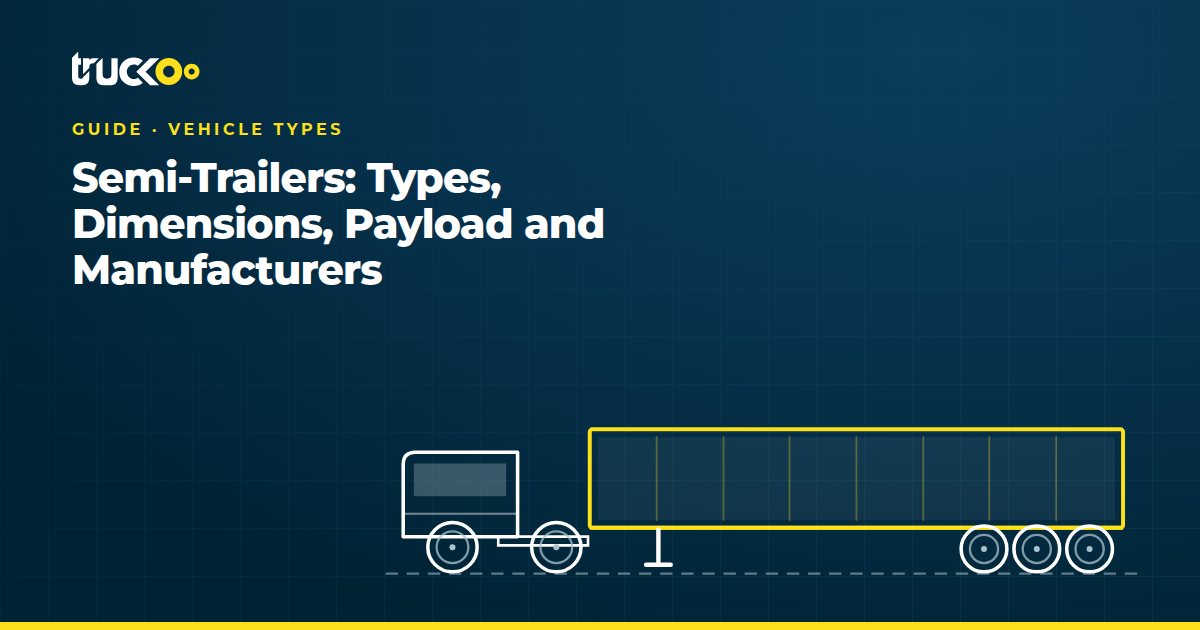
Curtainsider, box, reefer, tipper, tank: semi-trailer types, dimensions, payload, manufacturers and what matters when buying or selling a used semi-trailer.
The semi-trailer is the backbone of European freight transport: 13.6 m loading length, 33 pallets, up to 27 t payload – and no engine of its own. That is exactly what makes it the most traded used vehicle in the commercial vehicle market. Which types exist, what sets them apart, which dimensions and weights apply, who builds them and what to look for when buying and selling.
A semi-trailer (trailer, articulated trailer) is a trailer without a front axle that rests via its kingpin on the fifth wheel of a tractor unit. Part of its weight – the fifth-wheel load, usually 10 to 12 t – is carried by the tractor unit, the rest by its own axles. Together they form the articulated combination, in Germany up to 40 t gross combination weight (44 t in combined transport). The difference from a drawbar trailer: a drawbar trailer has its own front axle or drawbar and runs behind a rigid truck as a road train.
The standard for general cargo and palletised freight: sliding side curtains, sliding roof, stanchions, loading from three sides and by forklift. Variants: Standard (interior height around 2.7 m), Mega (3 m interior height for volume goods, low fifth-wheel height), Jumbo (stepped loading floor), coil well for steel coils, Joloda rails for paper reels. With certification to DIN EN 12642 Code XL, the body takes over part of the load securing.
Closed body made of sandwich panels, rear doors, often a tail lift and double-deck equipment. For parcels, furniture, electronics, textiles – anything that has to travel dry, clean and theft-proof. Heavier than the curtainsider, but no load-securing problems against the weather.
Insulated box with refrigeration unit (Thermo King, Carrier) and ATP/FRC approval for food and pharmaceuticals, often with a partition wall for two temperature zones. The unit has its own operating hours – on the used market the most important price factor besides the year of manufacture.
Steel or aluminium body with hydraulic cylinder for bulk goods: sand, gravel, asphalt, grain, scrap. Aluminium bodies are lighter and offer more payload, steel bodies cope with rubble and scrap. What distinguishes tippers is explained in the guide What is a tipper?.
Open platform for building materials, steel, machinery; as a low loader with a lowered loading deck for construction machinery and tall loads.
Tank semi-trailers (mineral oil, chemicals, food), silo semi-trailers (cement, flour, plastic granulate), container chassis (20 to 45 ft, often extendable), walking floor (moving floor for wood chips and waste), car transporters, swing-wall and beverage semi-trailers, deep-freeze and pharma trailers.
The binding values are stated in the Zulassungsbescheinigung Teil I (registration certificate part I): field F.1 (technically permissible maximum laden mass), field G (unladen mass), plus the axle loads and the fifth-wheel load.
Semi-trailers with a gross vehicle weight above 10 t need the annual roadworthiness inspection (HU) plus the additional safety inspection (SP). Reefers need the ATP certificate (every six years, then every three years), tank semi-trailers the ADR inspection. The driver needs a category CE licence. The truck toll is charged via the tractor unit; the number of axles on the semi-trailer is factored into the toll rate.
Three manufacturers dominate the European market: Schmitz Cargobull (market leader, curtainsiders, box trailers, reefers, tippers), Krone (curtainsiders, box trailers, reefers, swap bodies) and Kögel (curtainsiders, tippers, box trailers). In addition Wielton (Poland, also Fruehauf and Langendorf), Schwarzmüller and Kässbohrer (tippers, tank, silo), Lamberet and Chereau (reefers), Fliegl, Humbaur, Feldbinder and Spitzer (silo), Menci and Carnehl (tippers), Goldhofer, Faymonville and Nooteboom (low loaders). On the used market, the most sought-after are Schmitz, Krone and Kögel curtainsiders from fleet de-fleets aged two to six years.
Semi-trailers have no engine and no emission standard, so they age more slowly than tractor units and are traded across Europe – the used market is larger and more liquid than for any type of truck. Value is determined by manufacturer, year of manufacture, body type (reefers and tippers hold their value best, standard curtainsiders are the most liquid), axles and brakes, tyres, condition of curtain or box, on reefers the refrigeration unit, and the inspection status (HU, SP, ATP). Export buyers in Eastern Europe, the Middle East and North Africa also take older units; which rules apply there is explained in the guide Exporting used trucks. A concrete figure for your semi-trailer is provided by the free valuation based on real sales; after that, verified dealers from 35+ countries make binding offers – sell your semi-trailer with truckoo.
The semi-trailer has no front axle and rests via its kingpin on the fifth wheel of the tractor unit; part of its weight is carried by the tractor unit. A drawbar trailer has its own front axle or drawbar and is hitched to the towing coupling of a rigid truck.
Standard semi-trailers have a loading length of 13.6 m; in Germany the complete articulated combination may be 16.5 m long, 2.55 m wide (reefer 2.6 m) and 4 m high.
33 Euro pallets (1,200 × 800 mm) on one level, up to 66 with double-deck equipment; industrial pallets (1,200 × 1,000 mm) 26 units.
In a 40 t articulated combination practically 24 to 27 t, depending on the unladen weight of the tractor unit and semi-trailer. The gross vehicle weight of the semi-trailer itself is usually 35 to 39 t, but is never fully used in the combination.
Schmitz Cargobull, Krone and Kögel for curtainsiders and box trailers, Schmitz and Lamberet for reefers, Schmitz, Kögel, Schwarzmüller and Kässbohrer for tippers – thanks to spare parts supply, axle quality and export demand.
Gabriel Böhm is Managing Director of truckoo GmbH, the digital platform that is redefining commercial vehicle trade in Europe. With a passion for innovation and efficiency, he shapes the strategic direction and drives operational excellence to connect sellers and buyers smarter, faster and more transparently.
More practical knowledge about selling, valuation and documents.
The registration certificate, mileage and photos are all you need. Verified dealers bid bindingly and you decide – free of charge and with truckoo as your contractual partner.

.svg)