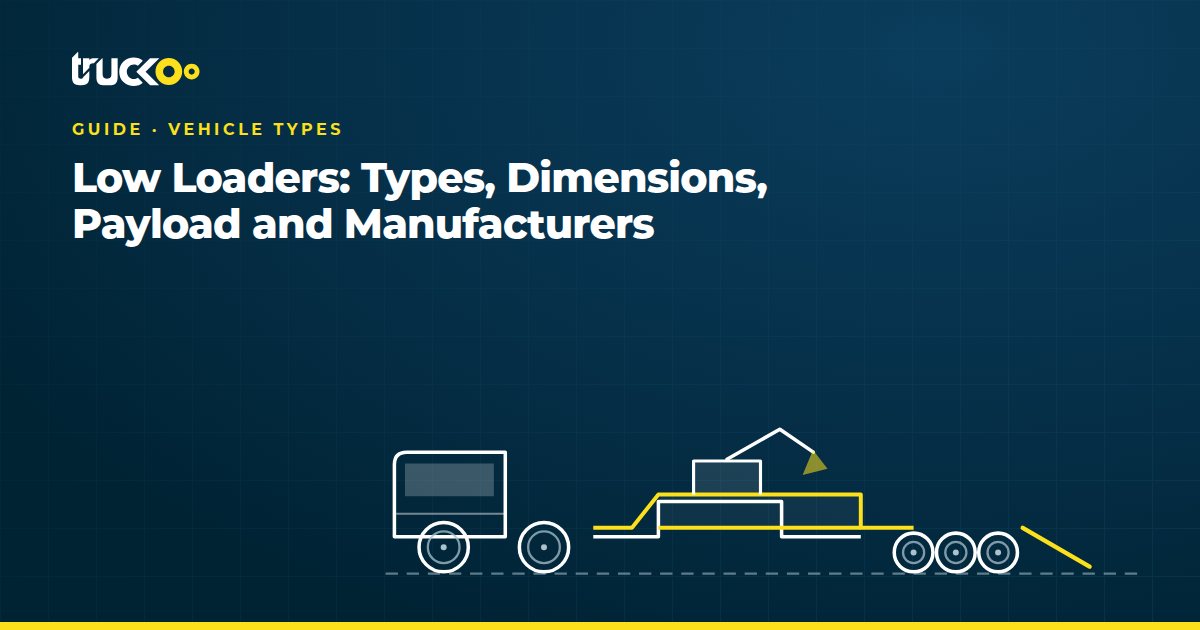
Low bed, semi and tandem low loaders: designs, payload, deck height, permit limits, manufacturers and what matters when buying a used low loader.
A low loader carries what will not fit on any standard trailer: excavators, wheel loaders, combine harvesters, forklifts, transformers. The trick is the lowered deck – it keeps tall loads under the 4-metre limit and the centre of gravity low. Which designs exist, what they carry, which rules apply from what point and what to look out for when buying and selling.
A low loader is a trailer or semi-trailer whose deck sits considerably lower than that of a standard semi-trailer – depending on the design, between roughly 30 and 90 cm above the road surface instead of around 1.2 to 1.4 m. This makes it possible to transport tall and heavy machinery without exceeding the permitted overall height of 4 m, and the machines can drive on themselves via ramps. Low loaders are the standard equipment for construction machinery, agricultural machinery and heavy haulage.
The most common form: semi-trailer with a gooseneck at the front, deck at medium height (around 80 to 95 cm) above the axles at the rear, loading ramps behind. Two to four axles, often with steering or pendle axles, sometimes extendable. Payload typically 25 to 40 t. For excavators up to around 30 t, wheel loaders, rollers, forklifts and containers – the all-rounder in the construction and rental business.
The deck sits as a bed between the gooseneck and the axle assembly, often only 30 to 50 cm high. The gooseneck is usually detachable so that the machine can drive on from the front. For very tall loads (large excavators, transformers, presses) and payloads of 40 to over 100 t with a correspondingly high number of axles. Almost always subject to a permit.
Centre-axle or turntable trailer behind a rigid truck, two to three axles, payload around 10 to 20 t. For mini excavators, wheel loaders, smaller construction machinery and municipal equipment; runs behind 18-tonners or 7.5-tonners with the appropriate towing capacity. Driving licence category CE or C1E.
Vessel bridges for transformers and tanks, telescopic low loaders for wind turbine blades and bridge sections, dollies and modular trailers (Goldhofer, Scheuerle) for abnormal and heavy haulage beyond 100 t. For the used market, semi and tandem low loaders are the most relevant.
Without a special permit, the following applies in Germany: articulated vehicle maximum 16.5 m long, 2.55 m wide, 4 m high, 40 t gross combination weight (44 t in combined transport), axle loads of 10 to 11.5 t depending on the axle. A three-axle semi low loader behind a two-axle tractor unit can therefore legally carry around 25 to 27 t, slightly more behind a three-axle tractor unit.
Anything above that is abnormal or heavy haulage: a permit under § 29 (3) StVO (German Road Traffic Regulations, for the journey) and an exemption under § 70 StVZO (German Road Traffic Licensing Regulations, for the vehicle), applied for via the VEMAGS portal. Many low loaders hold a permanent permit for specific routes or dimensions – it is tied to the registered keeper and does not automatically transfer on sale. Anyone buying a low loader with an exemption has to apply for it again.
The market is European and dominated by mid-sized companies: Goldhofer and Faymonville (heavy haulage up to modular trailers), Nooteboom and Broshuis (Netherlands, semi and low bed), Müller-Mitteltal (tandem and semi low loaders), Fliegl, Schwarzmüller, Kässbohrer, ES-GE, Doll, Humbaur (tandem up to 18 t), Meusburger, Langendorf. On the used market, semi low loaders from Goldhofer, Faymonville, Nooteboom and Müller-Mitteltal are in particular demand because spare parts and service are available across Europe.
Which documents are needed for the sale is explained in the guide important documents for selling a truck; what a legally sound purchase contract looks like is explained in the guide selling with legal certainty.
Low loaders hold their value longer than almost any other trailer: they have no engine that ages, demand from the construction industry, rental companies and export is constant, and good makes run for 20 years and more. Value is determined by the manufacturer, number and type of axles, payload, ramp design, frame condition and HU/SP. Export buyers in Eastern Europe, the Middle East and West Africa also take older units as long as the frame and axles are in good order – which age limits apply there is explained in the guide exporting used trucks. A specific figure for your vehicle is provided by the free valuation based on real sales; after that, verified dealers from 35+ countries make binding offers – sell semi-trailers and trailers with truckoo.
On a low bed low loader, the deck sits between the gooseneck and the axles, often only 30 to 50 cm high, and the gooseneck is detachable. On a semi low loader, the deck sits above the axles at a height of around 80 to 95 cm, and loading is done via ramps from the rear. Semi low loaders are lighter, cheaper and can be used without a permit up to a gross combination weight of 40 t.
Tandem low loaders around 10 to 20 t, three-axle semi low loaders without a special permit around 25 to 27 t (limited by the 40 t gross combination weight), with a permit 40 to over 100 t depending on the number of axles. The binding payload is stated in the registration certificate as the difference between the gross vehicle weight and the unladen weight.
Only if the load or vehicle exceeds the limits: 16.5 m length, 2.55 m width, 4 m height, 40 t gross weight or the permitted axle loads. In that case, a permit under § 29 StVO and an exemption under § 70 StVZO are required, applied for via VEMAGS.
For semi and low bed low loaders behind a tractor unit, category CE. For tandem low loaders behind a truck also CE; behind a 7.5-tonner, C1E is sufficient if the combination does not exceed 12 t.
Goldhofer, Faymonville, Nooteboom, Broshuis and Müller-Mitteltal – because of spare parts supply, frame quality and stable demand in export.
Gabriel Böhm is Managing Director of truckoo GmbH, the digital platform that is redefining commercial vehicle trade in Europe. With a passion for innovation and efficiency, he shapes the strategic direction and drives operational excellence to connect sellers and buyers smarter, faster and more transparently.
More practical knowledge about selling, valuation and documents.
The registration certificate, mileage and photos are all you need. Verified dealers bid bindingly and you decide – free of charge and with truckoo as your contractual partner.

.svg)