Swap body explained: classes C745 and A1360 under EN 284, dimensions, pallets, box, curtainsider, reefer, manufacturers and what matters with used units.
Swap bodies are the reason parcel carriers and groupage hauliers can transship at night without a truck standing idle: the container stands on its own legs while the truck drives on. Here is what a swap body actually is, which classes and dimensions the standard prescribes, how many pallets fit inside, who builds them and what to look for when buying and selling used units.
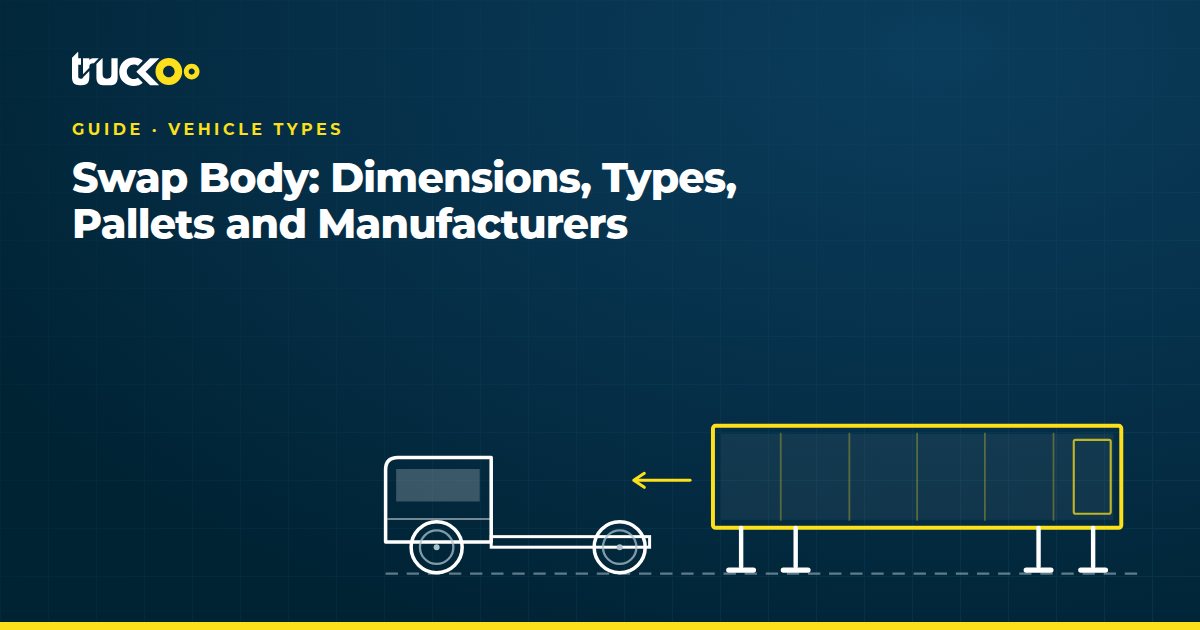
A swap body (also called a demountable body or, in German, Wechselbrücke/WAB) is a standardised load carrier with four fold-out support legs. A truck fitted with a swap-body carrier drives underneath, lowers its air suspension, lifts the body as it drives off – or sets it down in reverse. Transshipment takes place without a crane and without a loading ramp, in a few minutes and by a single driver. Thanks to grappler pockets, swap bodies can also be lifted onto rail wagons by crane, which is why they are the standard unit in combined road–rail transport.
Unlike a semi-trailer, a swap body is not a vehicle: it has no axles, no registration and no periodic technical inspection. The vehicle is the rigid truck or trailer with the demountable frame on which the body is secured by twist locks or centring cones.
The standard DIN EN 284 defines two classes that make up almost the entire fleet in service:
The external height is usually 2.67 to 2.9 m, the internal height 2.45 to 2.7 m; the floor height of the body must match the carrier frame (support legs for vehicle heights of roughly 1.0 to 1.3 m). The identification code on the body (for example C745) states class and length, together with tare weight, gross weight and year of manufacture.
A road train with two C745 units therefore holds 36 pallets, three more than an articulated truck – one of the reasons why groupage networks rely on swap bodies. With double-deck equipment the number of positions doubles.
The closed dry-freight box made of sandwich panels or aluminium, with a roller shutter or barn doors at the rear and often a side door. The workhorse of parcel carriers (DHL, DPD, GLS, Hermes) and groupage networks. Tare weight around 2.3 to 3 t.
Sliding curtains and sliding roof as on a curtainsider semi-trailer, forklift loading from three sides. For pallet and industrial traffic; with a Code XL certificate under EN 12642 the body takes over part of the load securing.
Insulated box with refrigeration unit and ATP/FRC approval for food and pharmaceuticals, often with a partition wall for two temperature zones. Heavier (tare weight up to 4 t) and the most valuable segment on the used market – the refrigeration unit and its operating hours determine the price.
Open platform with dropsides for building materials and bulky goods, swap tank, swap silo, beverage swap body with swing-out walls, swap body with tail lift or double deck. How flatbed bodies differ is explained in the guide on flatbed trucks.
Class C runs on two- or three-axle rigid trucks from 18 t gross vehicle weight (Mercedes-Benz Actros and Atego, MAN TGM and TGS, DAF CF, Volvo FM, Scania P) with a swap-body carrier and air-suspended lifting frame, plus a tandem-axle or turntable drawbar trailer with a second carrier frame. Class A runs on swap-body semi-trailers. The carrier frame itself is a value-determining component: when selling a swap-body rigid truck, the condition of the lifting frame, twist locks and centring cones counts too.
Krone (Dry Box, Box Liner, Profi Box), Schmitz Cargobull (W.KO box, W.CS curtainsider), Kögel (swap bodies and carrier frames), Wecon (box and curtainsider swap bodies, carrier frames), Spier, Sommer, Junge and Ackermann; refrigerated swap bodies also from Schmitz, Krone, Lamberet and Chereau. Among used units from parcel-carrier fleets, Krone and Wecon are the most common.
Swap bodies typically come onto the market in batches when parcel carriers or hauliers renew their fleets – often ten, twenty or a hundred units at once. Individual bodies are hard to market, whereas entire batches are in demand: with hauliers in Eastern Europe, with warehouse logistics providers as stationary storage space and in export. Value is determined by type (reefer ahead of box ahead of curtainsider ahead of flatbed), manufacturer, year of manufacture, condition of legs, floor and doors, and the number of units. How truckoo markets entire fleet disposals is explained on the sell your fleet page; a concrete assessment is provided by the free valuation, after which verified dealers from 35+ countries submit binding bids – sell swap bodies and trailers with truckoo. Which documents the sale requires is explained in the guide on important documents for selling a truck.
The ISO container is standardised for ship, rail and truck, stackable, with corner castings, but too narrow inside for two Euro pallets side by side. The swap body is tailored to European road transport: 2.55 m wide, with support legs for setting down without a crane, not stackable and not seaworthy.
18 Euro pallets in a C745, 19 in a C782, 33 in an A1360. A road train with two C745 units holds 36 pallets.
Class C: 7.15, 7.45 or 7.82 m long, class A: 12.2 to 13.6 m; both 2.55 m wide. The external height is usually 2.67 to 2.9 m.
No. The swap body is a load carrier, not a vehicle – it is the rigid truck and trailer with the carrier frame that are registered and inspected. Refrigerated swap bodies need the ATP certificate for food transport.
Any rigid truck or trailer with a swap-body carrier and air suspension with lift/lower function, usually from 18 t gross vehicle weight; for class A, a semi-trailer with a swap-body carrier.

Gabriel Böhm is Managing Director of truckoo GmbH, the digital platform that is redefining commercial vehicle trade in Europe. With a passion for innovation and efficiency, he shapes the strategic direction and drives operational excellence to connect sellers and buyers smarter, faster and more transparently.
More practical knowledge about selling, valuation and documents.
The registration certificate, mileage and photos are all you need. Verified dealers bid bindingly and you decide – free of charge and with truckoo as your contractual partner.

.svg)